I thought I knew Sudoku
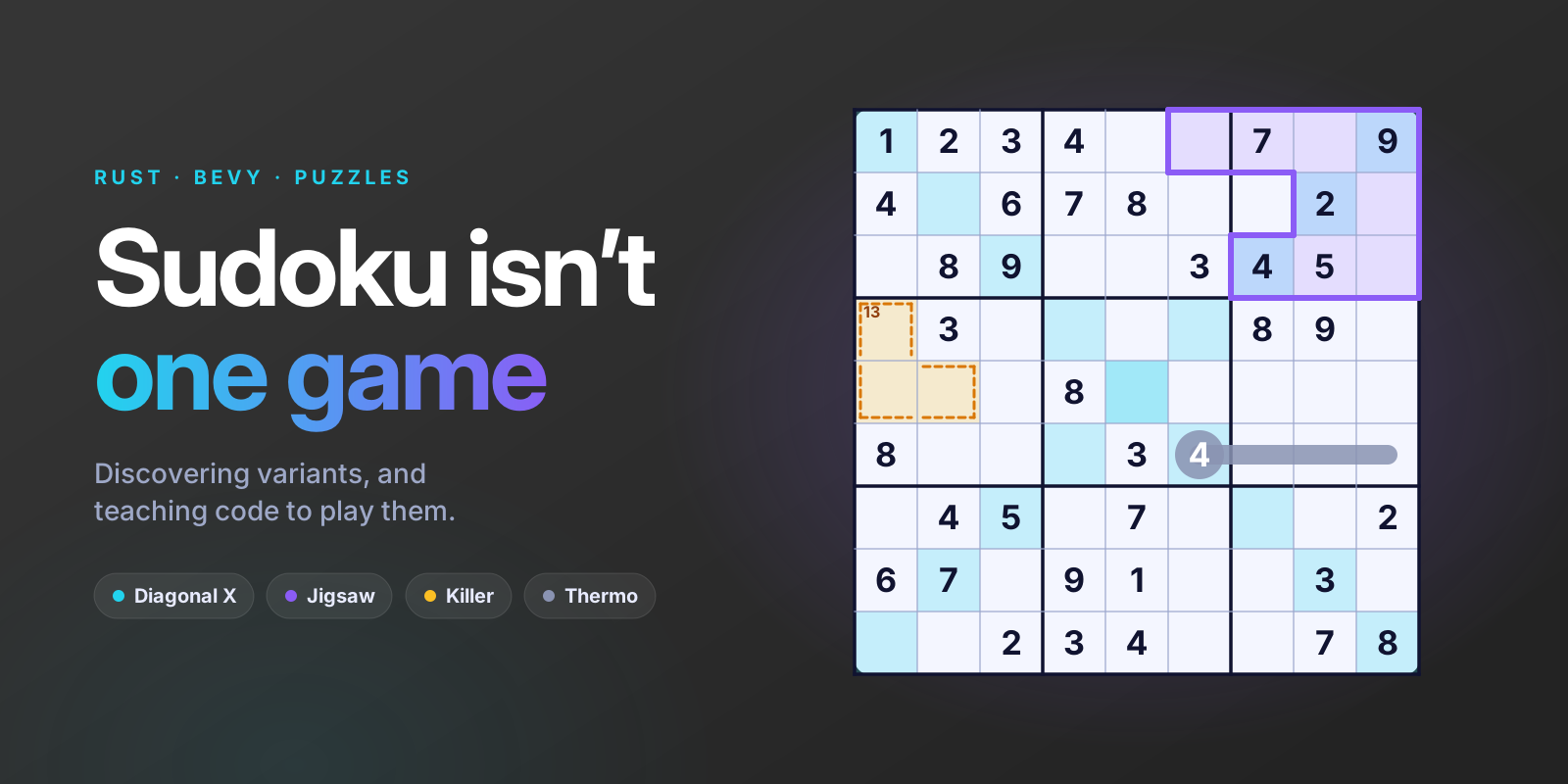
I thought I knew Sudoku. Nine rows, nine columns, nine boxes, digits 1 to 9, no repeats. I'd been solving puzzles for years, so when I decided to build a Sudoku game in code I assumed the hard part would be the interface.
Then I started reading about how people actually play. There are puzzles where the boxes are odd squiggles. Puzzles where you have to do arithmetic. Puzzles where you read a little drawing of a thermometer and let it tell you which digits can go where. People have been inventing new rules for decades, and I'd had no idea.
The variants I met
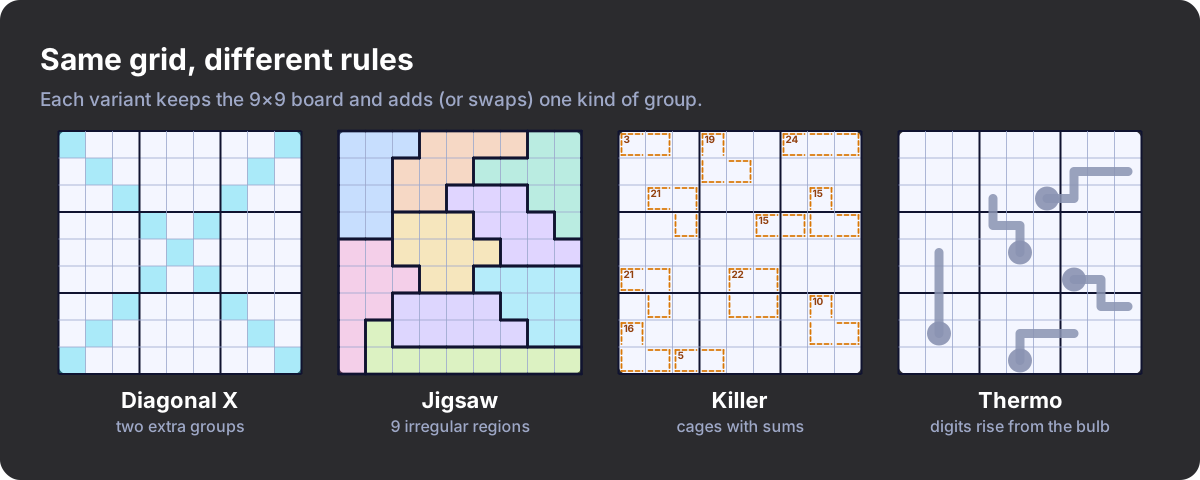
- Sudoku X adds the two long diagonals as extra groups. A digit in the middle of the board now has more to say about everything else.
- Jigsaw (irregular) Sudoku throws out the 3×3 boxes and uses nine connected blobs of nine cells instead. Your eye's habit of scanning boxes stops working.
- Killer Sudoku drops most or all of the given digits and draws "cages" with a target sum. Digits can't repeat inside a cage, and the cage has to add up exactly. It feels half Sudoku, half Kakuro.
- Thermo Sudoku draws thermometers on the grid. Digits must strictly increase from the bulb to the tip.
These aren't just harder Sudoku. A Killer solver thinks about which sets of digits can make 17 in three cells. A Thermo solver notices that the bulb of a four-cell thermometer can't be higher than a 6.
Rules, not modes
The obvious way to support several variants is a mode setting and a match on
it everywhere: validation, hints, solving, generating, drawing. That falls over
as soon as someone asks for Killer with diagonals, because the number of cases
grows with the number of combinations.
A variant isn't a mode. It's a list of rules.
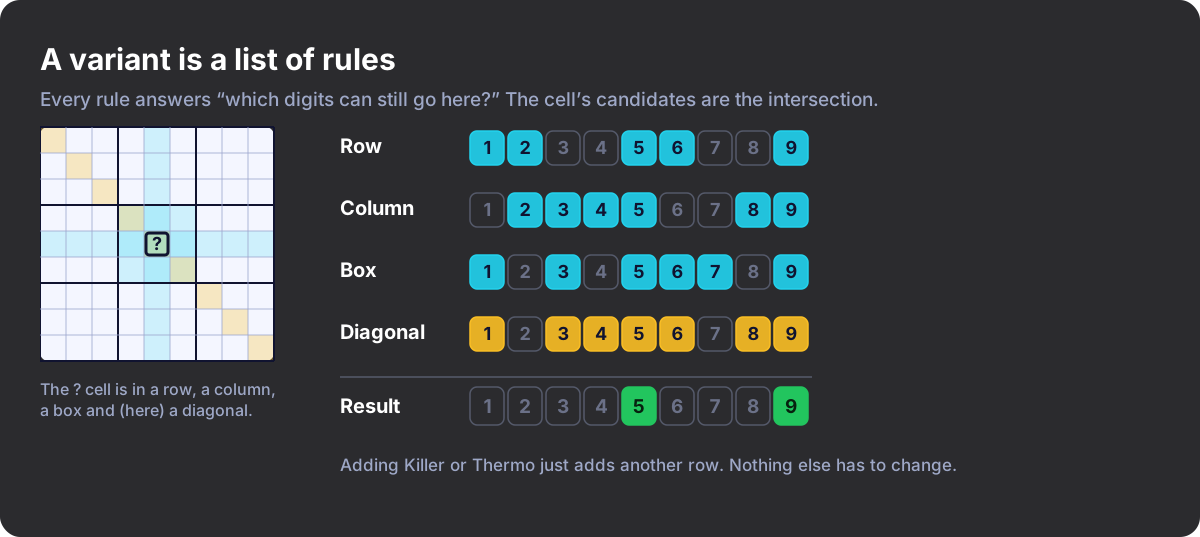
A rule only has to answer two questions: is the board legal as far as I'm concerned, and which digits can still go in this cell?
pub trait Constraint {
    fn name(&self) -> &'static str;

    /// True if this rule is not currently violated (ignores empty cells).
    fn is_valid(&self, board: &Board) -> bool;

    /// Digits still allowed in `cell` according to this rule alone.
    fn candidates(&self, board: &Board, cell: CellId) -> CandidateSet;
}
A puzzle is a board plus a Vec<Box<dyn Constraint>>. Classic Sudoku is rows,
columns and boxes. Sudoku X is the same list with the diagonals added. Jigsaw
swaps in different regions for the box rule. Killer and Thermo each add one more
rule. To work out what can go in a cell, you intersect the candidates from every
rule.
The easy ones and the fiddly ones
Rows, columns, boxes and diagonals are all the same shape: a group of cells where no digit repeats. Sudoku X was a few dozen lines, mostly the coordinates of the two diagonals. Jigsaw was simpler still. The box rule already took a list of regions, so I could give it irregular ones.
Killer and Thermo were different, because their rules aren't about duplicates. They're about what is still reachable.
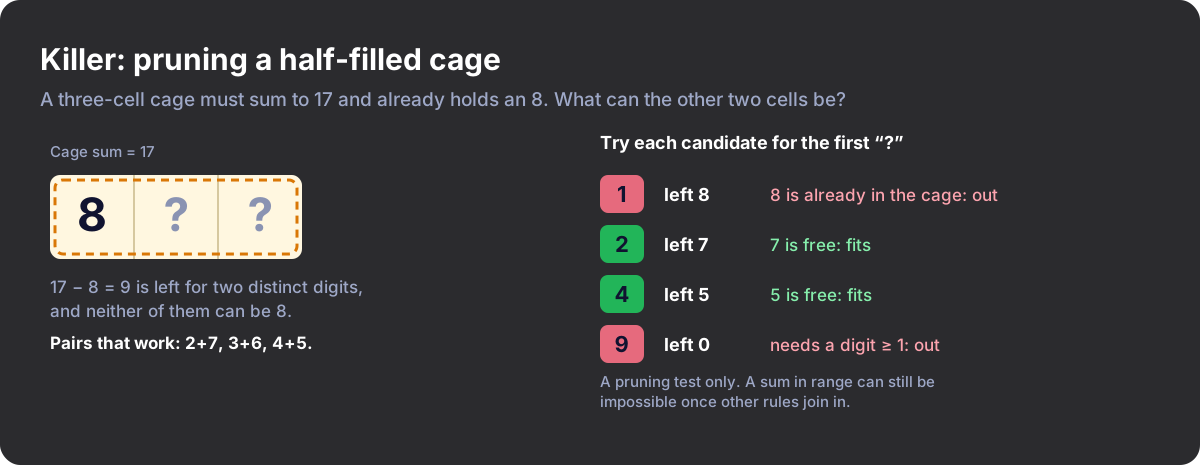
Killer cages. A finished cage either adds up or it doesn't, but a half-filled one needs more thought. If a three-cell cage needs 17 and I've placed an 8, the other two cells must sum to 9 using distinct digits, neither of them 8. For each candidate, I pretend it's already placed, then work out the smallest and largest sums the remaining cells could reach using distinct digits not already in the cage. If the remaining target falls outside that range, I discard the candidate. This is a pruning test, not a proof. A sum can sit inside the range and still be impossible once other rules get involved, so the solver's search has the last word.
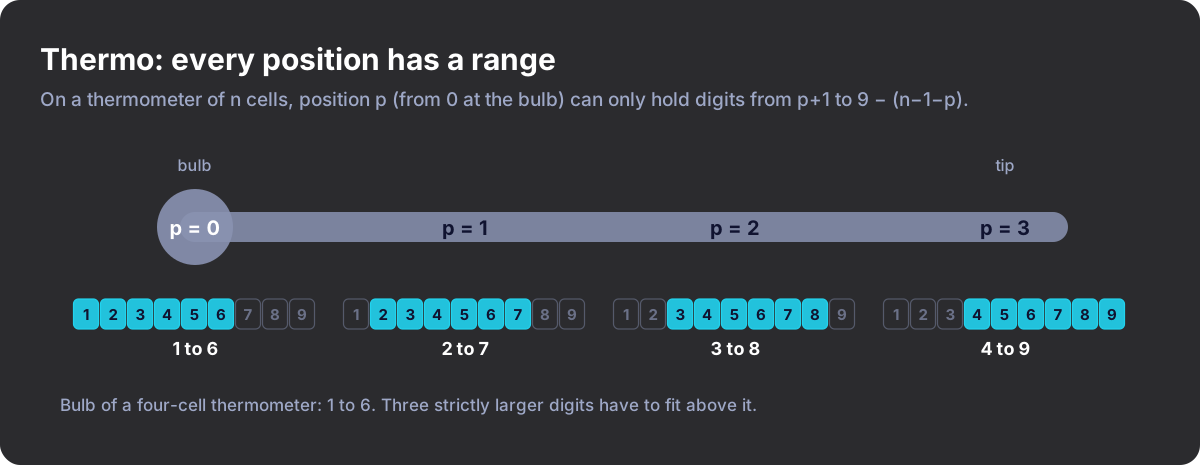
Thermometers. Checking that each digit is bigger than the one before isn't enough. On a four-cell thermometer, a 7 in the bulb is already impossible, because three strictly larger digits won't fit under 9. And if two cells two steps apart hold a 3 and a 4, no digit can sit between them, so the thermometer is impossible. So the gap between two filled cells has to be at least the number of steps separating them. The same idea gives each position a range. Counting positions from zero, the cell at position p of a thermometer with n cells can only hold digits from p+1 up to 9 − (n−1−p), where 9 is the largest digit. For the bulb of a four-cell thermometer that's 1 to 6, which is where that earlier claim comes from.
The solver
The solver is a backtracking search that always picks the empty cell with the fewest candidates. Before searching, it runs a propagation pass that fills in forced moves: cells with a single option, and digits that fit in only one place within a group. It doesn't know about Killer or Thermo. It asks every rule for candidates and works with what comes back.
Rules can also publish units, groups where every digit must appear exactly once. Rows, columns, boxes and diagonals do. Cages and thermometers don't. The propagation pass uses units to find hidden singles, so a variant with units gets that for free and one without loses nothing.
Generating puzzles
A good puzzle has exactly one solution. The basic recipe is the same for every variant: build a complete solution, then remove clues one at a time, keeping each removal only if the solver still finds a single answer. The variants each bend it a little.
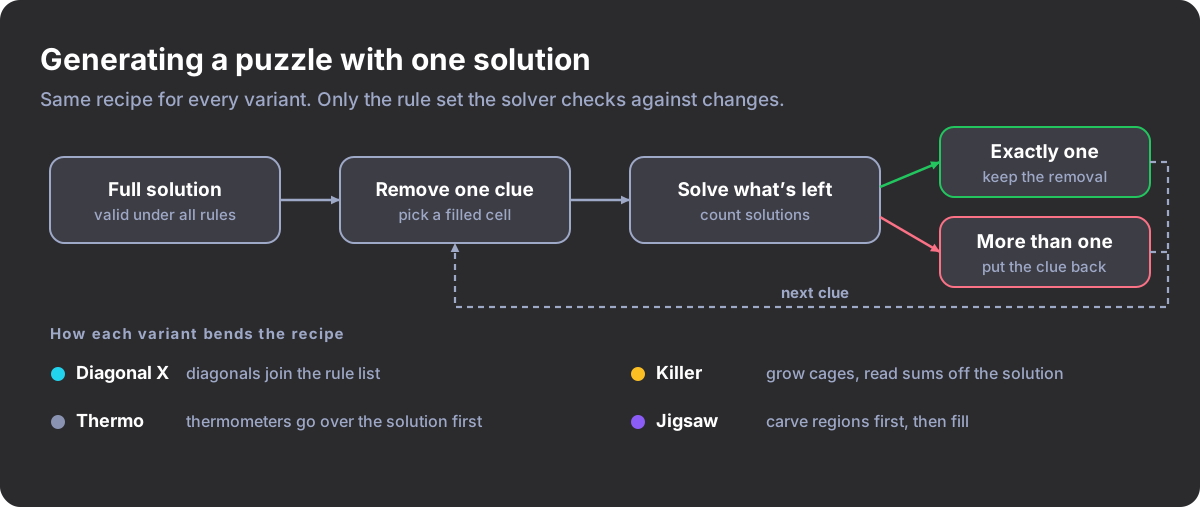
- Sudoku X needed almost nothing extra. It's the same carving with the diagonals in the rule list.
- Killer has no given digits, because the cage sums are the clues. I grow cages outwards over a finished solution, only absorbing a neighbouring cell if its digit isn't already in the cage, and read each sum off the solution. Uniqueness is checked against the full rule set (rows, columns, boxes and cages together), and if the layout has more than one solution I throw it away and try again. The maximum cage size is the main generation setting. Smaller cages tend to constrain digits more directly, while larger ones leave more possibilities to consider.
- Thermo works best as a lightly clued classic puzzle with thermometers on top, because thermometers alone rarely pin down a unique solution. Each thermometer is laid over the finished solution, stepping only to a neighbour with a larger digit, so it can always be satisfied. Clues are then removed with the thermometers in force, so uniqueness accounts for them. The clue count is the main generation setting. Fewer clues usually leave more to deduce, but it's a rough dial rather than a measure of difficulty: I don't measure how much work the thermometers do.
- Jigsaw reverses the order. The board is carved into nine connected regions of exactly nine cells first, and only then filled with a valid solution. A region layout isn't guaranteed to have a valid fill, so the fill gets a limited search budget, and if it fails I throw the layout away and start again. Getting nine blobs to tile the board evenly turned out to be a puzzle in itself.
What I took away
I'd played Sudoku for years without realising how much variety there was. Once I started looking, I kept finding new rules and new ways to combine them. Treating variants as collections of rules meant I could experiment without reworking the solver each time.
I'm still finding variants I've never heard of, and I can't wait to play them all. Sudoku has been one of my favourite pastimes for years, and these variants are making it more exciting than ever.