Resonata is a piano with no recordings inside it. Every note you hear is worked out on the spot from a felt hammer, one to three steel strings, a wooden soundboard and a room. It runs as a plug-in or as a standalone player, and it is free and open source.
This is the story of the first few days of getting it to sound like something. It is mostly a story about things I had backwards, and about the tests and measurements that told me so. I've kept the numbers in, because I'll want to know later whether I broke something.
What happens when you press a key
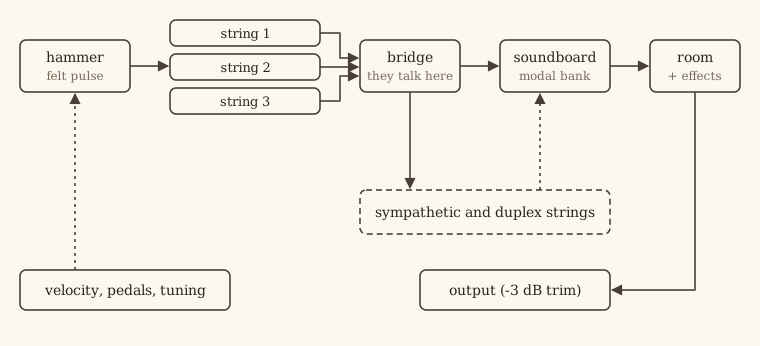
Each key owns a small group of strings: one in the bass, two through the tenor, three in the treble. A hammer sends a short pulse into them. They all meet at the bridge, which is where they push on one another, and the bridge drives a soundboard. Off to the side, some other strings sit waiting to sympathise. After that it is just a room and whatever effects you have switched on.
None of that is new. Julius Smith, Balázs Bank, Vesa Välimäki and others worked it out long before I came along, and the reading list is at the end. What I can add is a list of ways to get it wrong.
A string is a delay line
A struck string is a wave running up and down it. In the computer that becomes a delay line the length of one trip, with a filter in the loop that loses a little energy each time round. The pitch comes from the total delay:
\[ f_0 = \frac{f_s}{D} \]
where \(f_s\) is the sample rate and \(D\) is the whole loop delay in samples, including the delay the filters add. That last clause is where I came unstuck. I had subtracted a fudge of 1.5 samples for the filters. The real delay of the dispersion cascade was about 7. At C4 the piano played 55 cents flat, which is more than half a semitone, and I only found out because the fitting tool told me. The fix was to calculate each filter's exact phase delay and let a bisection find the fractional part. (Plain iteration just flips between two answers, and adding a fractional term on top counts it twice and costs another 5 cents. I tried both.) The tuning test now holds C2, C4 and C7 to within 5 cents.
Real strings are not harmonic
A stiff string sings slightly sharp as you go up its partials:
\[ f_n = n f_0 \sqrt{1 + B n^2} \]
\(B\) is the inharmonicity coefficient and it rises with pitch. Mine ran the other way round, heavy in the bass and almost nothing in the treble. The result was a C4 whose partials sat 4 to 9 cents flat of a pure harmonic series, which no stiff string does, and a C7 that was very nearly a sine wave. Turning the curve the right way up, and then calibrating the dispersion filters against the loop's real phase, put the C4 partials 2 to 12 cents sharp, as the theory says they should be.
An outside reviewer spotted this on first look. It's obvious once you know: a real treble note has audibly stretched partials, and a C7 that is nearly a pure sine wave has none of them.
Tuning a piano that is never in tune
Concert pianos are not tuned to equal temperament. The bass is tuned flat and the treble sharp, to meet the inharmonic partials halfway. That's called stretch, and piano tuners follow a curve described by Railsback.
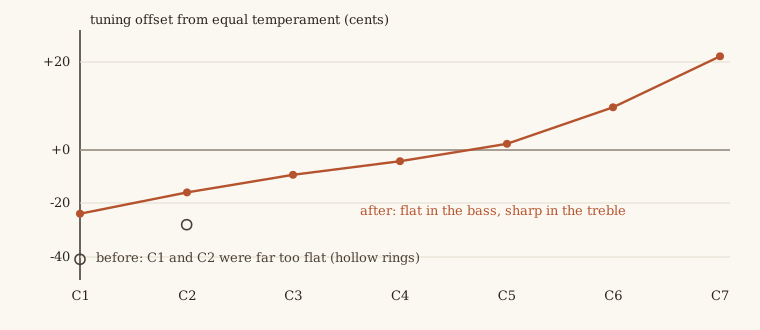
I had used one coefficient both ways and ended up with C1 at -41 cents and C2 at -28. The model matched its own curve exactly, which is a particularly irritating kind of bug: the string was right, the curve was wrong. The deviation at the two ends of a real Railsback curve is similar in size, roughly 25 to 30 cents, but there are far fewer semitones above A4 than below it, so the treble side is steeper per semitone. The coefficient is therefore now 0.20 below A4 and 0.35 above. C1 sits at -23.9 cents and C7 at +21.3.
The same all-octaves check found the top of the piano ringing too long. C6 lasted 2.53 s and C7 1.77 s, and I wanted something closer to half a second to a second. I lowered the decay floor from 1.2 to 0.9 s and got 2.08 and 1.41 respectively. That is closer, but I don't trust it yet. It's on my list to compare against a real instrument.
Where the hammer lands
The first version of the excitation was a pile of hacks. Each one broke something else, and a regression test that failed loudly was the only way I caught them.
First I stretched a short hammer burst across the whole loop. For a 26-sample burst and a 1381-sample bass loop that plays it about fifty times too slowly, so the spectrum collapsed below 500 Hz and louder notes came out darker. I dropped that altogether. Next I dropped the burst into an empty loop, which leaves the output at digital zero until the wave comes round again. At C1 that is about 31 ms of exact silence at the start of every note (at 44.1 kHz), and you can hear it. Then there was the loud-note problem: a white burst at fortissimo spreads a fixed amount of energy over 22 kHz while the loop sustains below 1 kHz, so the loud note ended up quieter than the medium one.
The version that survives injects the hammer's force pulse at a point 1/16 of the string length ahead of where the bridge reads the string, so the first tone arrives in under 2 ms even at C1. There is no pre-filled noise.
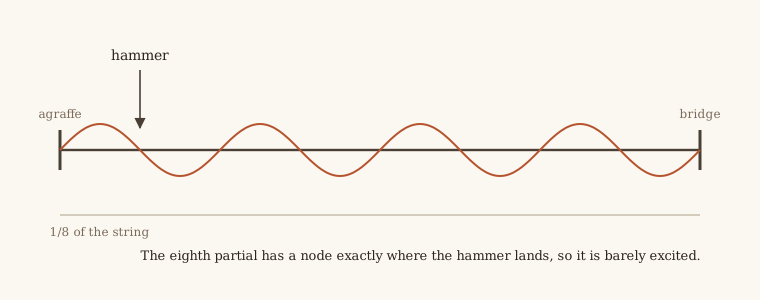
Where the hammer lands matters in a second way. A hammer that strikes at \(1/8\) of the string leaves every eighth partial almost silent, because those partials have a node there. The comb filter that does this was fake in my first attempt: I averaged the signal with a copy of itself delayed by one sample, which is a mild low-pass, not a notch. It's a proper feed-forward comb now, with dips at partials 8, 16 and 24 and hollow peaks between.
The hammer was lying about its age
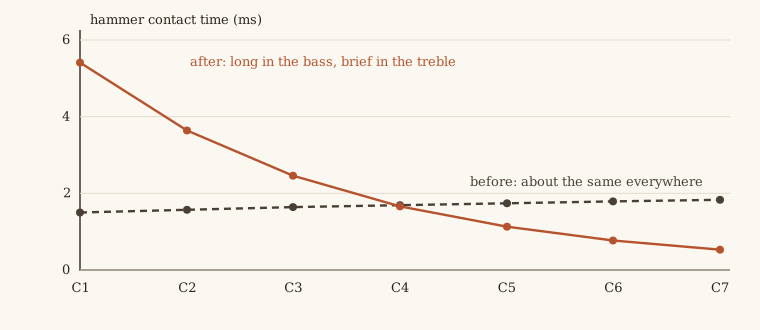
The hammer's felt touches the string for a few milliseconds, and how long decides which partials get excited. Short contact, bright treble. I had about 1.7 ms at every pitch. That is a low-pass filter at roughly the same corner everywhere, so the treble partials from the third upwards were being driven by flat noise. On top of that, the hardness law was inverted: a harder hammer rang for longer.
Now the contact time shortens by a factor of \(2^{-1/2}\) per octave, about 4.8 ms at C1 and 0.59 ms at C7 at a moderate velocity (0.6) and neutral hardness. The whole law is five lines of Rust:
let v = velocity.clamp(0.0, 1.0);
let h = self.hardness.clamp(0.25, 4.0).sqrt();
let base_ms = 3.0 - 2.2 * v;                    // harder blow, shorter contact
let register = 2f32.powf(-(f32::from(midi) - 60.0) / 24.0);
let ms = (base_ms / h * register).clamp(0.25, 6.0);
Dividing by \(\sqrt{h}\) is the other half of the fix. The old law handled hardness the wrong way round, which is why harder hammers rang longer.
The pulse shape took three tries. A haversine has spectral nulls that ate whole partials. A Gaussian was too dull. The one I kept is \(u e^{1-u}\) with a short fade at the end, and it has no nulls inside the audible band.
The treble also needed its loop filter replacing. It's now a one-pole filter solved per note so that partial 8 dies about three times faster than partial 1, while the fundamental still hits the decay time in the table. A test checks that the fundamental lands within 0.2 % and the ratio within 5 % at C4, C6 and C7.
Two strings that disagree
Strike a note with two or three strings and you do not get one decay. You get a quick fall as they move together, then a long, quiet tail as they drift apart and cancel at the bridge, which then barely moves. Pianists call the tail the aftersound.
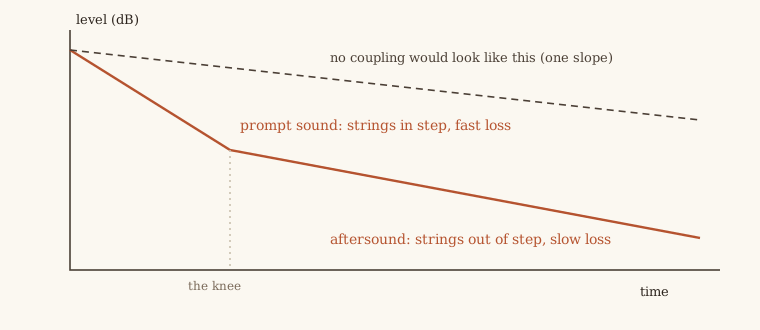
My first attempt at this was wrong in an instructive way. I had the strings subtract a share of their average from themselves, which drained energy from the in-phase motion, the part that should keep the normal decay. A slowly beating pair of strings stays near that in-phase state for seconds, so every note simply died too fast. I only noticed because I rendered the same notes with the previous build. C4 had gone from 6.57 s to 2.64 s.
The version that works adds a correction instead of taking one away:
\[ y_i \leftarrow y_i + \eta\,(y_i - \bar y), \qquad 1 + \eta = \rho^{\,1/P - 1}, \qquad P = 1 + 3c \]
Here \(\bar y\) is the average of the strings, \(\rho\) is the normal loop gain, and \(c\) is the coupling amount. The in-phase motion keeps its ordinary decay and the out-of-phase part rings up to \(P\) times longer. With detuned unisons, the first partial of C4 now has an aftersound of 12.2 s against 7.3 s with coupling off. With perfectly tuned strings nothing changes, which is correct too. (The model is Weinreich's, from 1977.)
In code it is a few lines. First the gain, worked out once when the note starts, with a ceiling so a silly setting cannot run away:
// Bridge coupling: eta = rho^(1/P - 1) - 1, P = 1 + 3c.
let p = 1.0 + 3.0 * coupling.clamp(0.0, 1.0);
let eta = (rho.max(1e-3).powf(1.0 / p - 1.0) - 1.0).clamp(0.0, 0.05);
Then, every sample, each string's output is pushed away from the mean of all the strings before it goes back into its own loop:
let mean = sum / n;                        // the bridge's motion
for (s, &v) in strings.iter_mut().zip(&outputs) {
    s.commit_looped(v, v + eta * (v - mean));
}
When the strings agree, \(y_i - \bar y\) is zero and nothing happens. When they disagree, the disagreement gets a little less loss than the agreement does.
Why it sounded like a synth
At one point I said it sounded like a synth. The reasons turned out to be small and specific.
Every string in a choir was tuned exactly the same, which is the most digital thing a piano can do. I added a gentle, deterministic wander per key, about 2.4 cents of tuning and 6 % of hammer strength, the same every time you play the key. Unison strings were also detuned by a fixed number of cents, so the beating got faster with pitch. At C7 it was 3.6 Hz, which sounds like a supersaw through a chorus pedal. The detune is now a constant beating rate of about 0.5 Hz. The last fix was the dryness: I nudged the room and sympathy defaults up (room 0.15 to 0.22, sympathy 0.5 to 0.6), because a piano with no bloom reads as a synth.
I also found, while chasing a different issue, that the loop gain was worked out from the length of the delay line rather than the loop period. That miscounted the number of times the wave went round, and made decays at C7 27 % too long. It's the kind of bug you don't hear as a bug. You hear it as 'hm, something is off about the top'.
One engine, seven instruments
The same machinery turned out to be most of a harpsichord, a clavichord, a fortepiano and a harp, with different excitations and a few extra stops.
- Harpsichord: a quill pluck rather than a hammer, with a buff (lute) stop.
- Clavichord: a brass tangent that stays on the string, so pressing harder after the note starts raises the pitch. That's called bebung. At full pressure it bends the note up about 25 cents.
- Fortepiano: light leather hammers, a moderator and a bassoon stop that rattles.
- Concert harp: finger-plucked strings that ring until you stop them, with pinch harmonics and a glissando pedal.
The two electric pianos needed new physics. The tine is a clamped-free beam whose modes sit in the ratio 1 : 6.267 : 17.547, plus a tone bar, read by a magnetic pickup. The reed is struck steel read by an electrostatic one. They had a start-up spike that took the output to 16, because I was differentiating a flux that began from zero rather than from rest. Starting the flux at its rest value fixed it.
All ten pedals work on all of them, and any four can sit on the on-screen pedals. The pedals I invented (super sostenuto, glissando) are defined in the manual, because there is no standard to follow.
Real time, and other things you only learn the hard way
The audio thread isn't allowed to wait for anything. No locks, no allocation, no files. I got this wrong, or something close to it, in three places, and found out about each one by accident.
- The standalone player shared its engine behind a lock and built a vector in every callback. It now owns the engine outright and receives MIDI through a ring buffer.
- The plug-in's smoothing did nothing. It read the raw value and then ran the smoothers into a buffer it threw away. Every knob move was a step, so you would have heard zipper noise on every parameter. Parameters are now smoothed per 64-sample block.
- The meter decayed up to 64 times too slowly, because a per-sample factor was being applied once per block.
The editor had its own bug. The meter and lamps only moved while the cursor was over the window. The graphics toolkit draws a frame only when an event wakes it, and the audio thread's polite request to redraw is only looked at just before drawing, which nobody triggers. A 15 frames-per-second timer fixes it.
The sound has its own budget. A worst-case pile-up (the full 32 voices, with the sustain pedal down and every effect on) runs at about 11 times real time on a two-core cloud machine. SIMD bought most of that: groups of strings in one instruction, and the soundboard modes in two banks of eight. The unoptimised version of that test is far slower, so the speed check only runs on release builds.
The tests argued back
Some of my tests were wrong, or failed for the wrong reason, and those taught me the most.
- A test of treble partial sharpness passed for weeks. I later found it was passing on noise: the old sustain had partials 3 to 6 all at about -7 dB, the signature of flat noise, and a flat spectrum has something near every expected frequency. Once the noise went, the test had to ask for real structure.
- The golden-file test compares a render against a stored one. It flagged clipping that a mono peak hid: the left channel reached +1.05 while the right sat at +0.59, which averages to a comfortable 0.82.
- Measuring late in the note, not early, was the only way to see anything about pedals. The release transients are loud in every case and drown the effect.
- Tests of the tools mattered as much as tests of the piano. A parabolic peak-picker with a sign error put every B measurement out by 9 cents, and I'd have been tuning the piano to fit a broken ruler.
- When I put the plug-in through a validator, it found two places where a clamp had its limits the wrong way round at very low sample rates, and a phaser that went unstable once its frequency passed half the sample rate. It now survives anything from 1 kHz to 768 kHz.
Things that fooled me
A few measurements fooled me for longer than they should have.
At C6 the analysis showed a fundamental 19 dB down, a hole that was not there. I had told the analyser to expect a perfectly tuned string, but with the piano's natural stretch a comb mode of the room at 1046.2 Hz sat 0.3 Hz from my prediction and stole the slot. The string was fine.
A bump at 2.7 to 3 kHz looked like a resonance. It was two nearly equal partials, one longitudinal and one transverse, 3 to 4 % apart, that a peak-picker kept confusing. The soundboard was innocent.
After one rebuild the treble measured identical to 0.1 dB. That was not a subtle bug: the plug-in in the host had not been rescanned, so I was listening to the old binary.
Then there was my own playing. I compared a recording of it with a reference recording and the numbers were miles apart: centroid 5251 Hz against 730 Hz. I assumed the synth. I rendered a single note and measured it the same way, and it sat with the reference. The difference was me: playing about 1.4 times too fast, nothing below E4, one volume throughout, in a dry, narrow recording. I changed no code.
The rest of the box
There's more in there than I have the room to explain properly, so here is the short version.
- Effects: tremolo, wah, chorus, flanger, phaser, fuzz, delay, amp simulation, compressor and two equalisers. Each is bit-for-bit transparent when off.
- Rooms: a light built-in reverb, and a convolution mode with four synthesised spaces or an impulse response of your own. It adds no latency.
- Spatial: first-order Ambisonics output and a decode to a 7.1.2 bed.
- Tuning: temperaments, Scala files and stretch.
- Tools: an analyser for recordings, a fitter that learns voicing from a recording, and a blind-test page generator.
- The fitter: the engine has hard switches in it (felt, dampers), so I couldn't differentiate it. It estimates gradients by perturbing every parameter at once and rendering twice, a method called SPSA. On a test target it brings the spectral distance down by 20 to 50 % in 40 steps.
How it holds up
| What | Result |
|---|---|
| Worst-case pile-up, every effect on | 11.2 times real time (2-core x86) |
| clap-validator | 36 passed, 0 failed, 8 skipped |
| Sample rates | 32 to 96 kHz sound alike |
| Survives without crashing | 1 kHz to 768 kHz |
| Single C1 at full velocity | peaks at 0.77 of full scale |
That last row is a trim of 3 dB that I added at the end. A low note at full velocity used to go just past full scale before any effects.
/// Fixed -3 dB master trim, 10^(-3/20), applied with the Volume control.
pub const OUTPUT_TRIM: f32 = 0.707_945_8;
// ...
let vol = self.params.volume * OUTPUT_TRIM;
Reading
If you only read five things:
- Julius O. Smith, Physical Audio Signal Processing.
- Bank, Välimäki and colleagues on piano modelling: commuted synthesis, soundboards, dispersion.
- Chaigne and Askenfelt on numerical hammer and string models.
- Giordano and Jiang on the hammer-string interaction.
- Weinreich (1977) on coupled piano strings.