Language learners tend to split into two camps. One group uses flashcards and a spaced repetition scheduler, and will tell you their retention rate without being asked. The other group likes quizzes: multiple choice, matching games, typing answers, saying things out loud. Each camp thinks the other is wasting its time.
For a while I assumed I had to join one of them. I've now spent long enough with both to think the question is the wrong way round. They do different jobs, and most of the frustration comes from using one to do the work of the other.
This post is about what each method is actually good for, the ways each one flatters you, and how I'd combine them. I've been learning Icelandic since the start of last year, after a long time with Swedish, so the examples lean that way. The ideas don't depend on the language.
Two facts about memory
Most of what follows rests on two old findings, so here they are first.
The testing effect says that pulling something out of your head strengthens the memory more than looking at it again. Roediger and Karpicke ran the well-known version of this: students who tested themselves on a passage remembered noticeably more a week later than students who simply re-read it. The surprise was that the re-readers felt more confident.
The spacing effect says that reviewing something at growing intervals beats cramming the same number of repetitions into one evening. Ebbinghaus drew the forgetting curve in the 1880s, and the finding has held up well ever since.
Flashcards and quizzes are both ways of cashing in on these two facts. They just do it differently.
What a flashcard is for
A flashcard is the simplest retrieval exercise there is. You see a prompt, you try to answer it, you flip the card, and you decide honestly whether you were right. Nothing else happens, which is the whole appeal.
Recall with nothing to lean on
If I show you 'horse' and you have to produce 'hestur' from nothing, no options and no first letter, that is free recall. It's the hardest kind of retrieval, so it's the most effective at making a memory last. It's also mildly unpleasant. A card that feels slightly too hard is usually doing its job.
The scheduling is the real product
You can do all of this with paper cards and a shoebox. The Leitner system is a lovely piece of low technology. Software does the bookkeeping better though. Anki records how well you knew each card and picks the next review date. Easy cards disappear for weeks or months. Cards you keep fumbling come back within days. You spend your time on what you're about to forget, not on what you already know cold.
Newer versions of Anki can use a scheduler called FSRS, which fits a memory model to each card and aims at a retention rate you choose, say 90 %. The older SM-2 algorithm is still there and works fine. I wouldn't spend an evening choosing between them.
My own Icelandic deck currently has 2200 cards, I'm on FSRS with the target set to 90%.
Cards can be more than a word and a translation
Most people begin with a word on one side and its meaning on the other, and that is fine for the first few hundred words. After that, cloze cards do far more. A cloze hides one word in a sentence, so you see:
Ég les ___ á kvöldin.
and you have to supply 'bækur' (or whatever the sentence wants). You learn the word, the case it takes, and a bit of rhythm from a real sentence, none of which an isolated translation will teach you. Audio on the card helps too, and so does a picture with no text, because it forces you to skip the translation step.
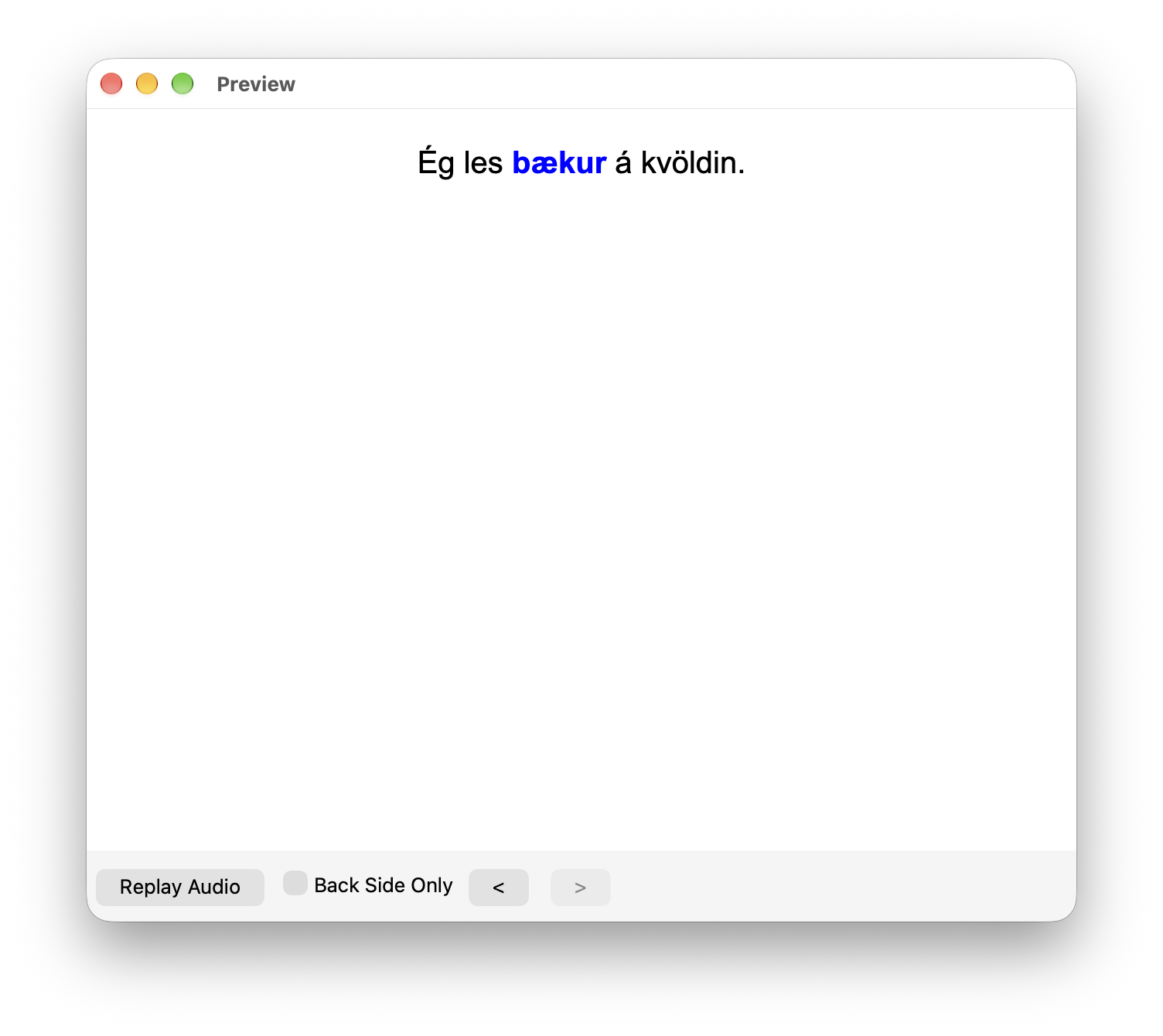
I switched to cloze cards after about 300 words. If I could give a new learner one piece of advice about flashcards, it would be to start making them early, because a single-word deck can't show you which case a noun is wearing.
Small enough to actually use
A deck lives on your phone, so five minutes in a queue or waiting for the kettle is a real study session. That sounds trivial and isn't. People who do ten minutes every day beat people who plan a perfect two-hour session and manage it twice a month.
What quizzes add
By quiz-style exercises I mean the things you find in Quizlet's Learn and Test modes, in Duolingo and Busuu, and in most other apps: multiple choice, matching, typed answers, written sentences and spoken prompts. It's less one method than a toolbox, and each tool trains something a little different.
Multiple choice
Multiple choice is the gentlest of them, because you only have to recognise the right answer. That makes it a good first meeting with a word, when producing it cold would just be frustrating.
It has a second use that people overlook. Good wrong answers make you tell similar things apart. If you're choosing between 'köttur', 'hundur', 'kýr' and 'hestur', the distractors force you to notice what actually separates them. The weakness is that recognition is much easier than recall. You can pass a multiple choice test on words you could never say aloud.
Matching
Matching games, where you pair words with translations against a clock, are quick and a little addictive. They build fast association between a word and its meaning, and the time pressure nudges you towards automatic recognition. I use them as a warm-up. Pairing ten words in thirty seconds feels like progress and some of it is real, though it's recognition only, so it's worth less as you improve.
Writing
Typing or handwriting an answer is where quizzes get serious. Producing a word letter by letter exposes every gap, from a missing accent to a wrong ending. This is the generation effect at work: things you produce yourself tend to stick better than things you only read.
Writing whole sentences goes further. If you can write two or three sentences using a new word, you can use it. If you can't, you only know it. That's a bigger gap than it sounds.
Speaking
Saying answers aloud is the exercise people skip most, and the one I'd defend hardest. It trains the muscle memory of pronunciation, it makes you retrieve at conversational speed with no time to stall, and over a few weeks it wears down the fear of opening your mouth. App-based speaking exercises are imperfect. Voice recognition can be fussy, and comparing yourself with a recording of a native speaker only goes so far. They still get you making sound, which beats silent study. A tutor or language partner is better, because software can't tell you whether you sound natural.
Variety helps by itself
Mixing formats has a benefit that has nothing to do with any one format. When you meet a word seen, heard, typed and spoken, the memory gets several routes in, and you're more likely to find one of them later. Bjork called effort that feels harder now and pays off later a 'desirable difficulty', and varied practice is one of those. It also keeps sessions from going stale.
How each one flatters you
Flashcards
Flashcards go on autopilot. After a few hundred reviews you can get faster and faster at the deck without getting any better at the language. They also isolate words, which in English is a mild problem and in Icelandic a serious one: a noun you know only in its dictionary form will turn up in the accusative, the dative or the genitive wearing a different ending, and you won't recognise your own flashcard. And a vague card, or one crammed with two facts, gets answered inconsistently, which the scheduler can't fix. If you hesitate over which answer a card wants, split it in two.
A card I had to split
One of mine was a listening card: the audio says Við töluðum við hvorn annan sí og æ, and the back says 'We were talking to each other all the time'. I'd learnt hvor and annar as dictionary headwords, but here they're in the accusative as hvorn annan, and the idiom sí og æ ('constantly') was squeezed onto the same card.
Worse, it was one of twelve near-identical cards, each changing a single ending or moving one word, all with the same English on the back. I could have marked every one of them 'Good' without noticing which ending I'd heard.
So I split it: one card for sí og æ, one for hvor annan / hvor aðra / hvort annað with the case spelt out, and one sentence kept for listening practice. The other eleven are suspended.
Quizzes
Quizzes flatter you in a different way. Multiple choice and matching feel easy, and that ease hides how much you haven't learnt. Some quiz apps are also weaker than a proper spaced repetition tool at long-term scheduling, so a word you got right once can fade quietly with nothing bringing it back. Streaks and points are motivating, but they can reward turning up over learning. A 400-day streak made of two-minute sessions is not the same thing as 400 days of progress, however pleased the little flame looks.
Both can be dull, and dull matters. A method you drop in week three loses to a worse one you actually enjoy.
Things that fooled me
A few things looked like evidence of progress for longer than they should have.
A high score in a matching game made me feel I knew a set of words. What it showed was that I could recognise them in a list of ten, which is a much lower bar. The test that mattered was whether I could write the word an hour later with nothing in front of me.
Getting a card right on the day I made it told me almost nothing either. The scheduler's first few intervals are short for a reason. A card that survives a month is knowledge. A card that survives ten minutes is short-term memory being polite.
Reading Icelandic and producing Icelandic also separated more than I expected. I could follow a sentence and then fail to build the same one. A quiz that only asked me to choose would never have shown that. Typing the answer did, within a week. For me it was Mér leiðist, 'I'm bored'. I understood it every time I heard it, but when I had to type it I wrote Ég er leiður, which is a perfectly good sentence that means 'I'm sad'. In Icelandic, boredom happens to you, so the sentence starts with the dative mér rather than ég. Recognising it had never made me notice that.
Putting them together
The shortest version I can give: flashcards are storage and quizzes are training. Spaced repetition makes sure what you learn stays learnt. Quiz-style exercises make sure what's in storage can be spelt, pronounced, put into a sentence and told apart from its lookalikes.
| Method | Trains | Difficulty | Best for |
|---|---|---|---|
| Flashcards | Long-term recall | High | Keeping vocabulary for good |
| Cloze cards | Recall in context | High | Grammar, cases, collocations |
| Multiple choice | Recognition | Low | First meeting, similar words |
| Matching | Speed and association | Low | Warm-ups, recent words |
| Writing | Spelling, grammar, usage | High | Accuracy, active vocabulary |
| Speaking | Pronunciation, fluency | High | Being ready for conversation |
In practice I'd go from easy to hard. Meet a fresh batch of words with multiple choice or matching, where nothing is at stake. Move the ones you want to keep into your flashcard tool, preferably as cloze sentences with audio. Review daily and say your answers out loud. It might feel silly for about a week. But it's worth it.
Then, every so often, switch to production. Once a week, type the words from memory and write a few sentences with them. Record yourself now and then. Finally, go and meet the words somewhere real, in a book, a podcast or a conversation. That's the step people skip, and it's the one that shows you which words are yours and which only live in your deck.
If you had about half an hour a day, one version of the week might look like this. Change it to suit your life.
| When | Time | What |
|---|---|---|
| Every weekday | 10 min | Flashcard reviews, answers spoken aloud |
| Three of those days | +10 min | New words via multiple choice or matching, then into the deck |
| The other two days | +10 min | Writing: type words from memory, write a few sentences |
| Weekend | Longer | One longer session |
Mistakes I'd avoid
Adding too many new cards is the classic. Every new card creates a pile of future reviews. I started with 20 new cards a day, and a month later I was facing about a hundred reviews every morning and had begun to resent my own deck. Start with fewer than you think you can handle.
Downloading other people's decks saves time, but you lose much of the benefit of making the card yourself, because choosing the example sentence is part of the learning. I downloaded a shared deck, 'Icelandic – 6500 sentences sorted by ease', and only looked at it closely after I'd imported it. The audio is computer-generated speech rather than a native speaker. The same English sentence often has a dozen near-identical Icelandic cards that differ by one ending, with nothing to say which ending is which. And there are a few mistakes: Ég er þreitt where it should be þreytt, and einmanna for einmana. If I'd made those cards myself, I'd have had to look each word up, and I'd have caught the mistakes.
And don't treat the app as your whole course. Flashcards and quizzes support the reading, listening and talking; they can't stand in for them.
Other platforms
So, which one?
Both. Flashcards give you durability: with spaced repetition, words stay in your head for months and years. Quizzes, writing and speaking give you range, because they turn stored words into things you can do. On their own, each leaves a gap. A learner who only does flashcards can know thousands of words and freeze in a conversation. A learner who only does quizzes can feel fluent inside the app and have forgotten most of it a month later.
The platform matters much less than turning up regularly and making your brain do the retrieval.
Reading
- Roediger and Karpicke (2006), 'Test-enhanced learning: taking memory tests improves long-term retention'. The testing effect study. DOI · PubMed
- Cepeda and colleagues (2006), a review of the spacing effect. Start here for how far apart to space reviews. DOI · PubMed
- Slamecka and Graf (1978), the paper that named the generation effect. Why typing beats recognising. DOI
- Bjork and Bjork on desirable difficulties. Why the harder format is often the better one. PDF from the Bjork Lab
- Ebbinghaus (1885), Über das Gedächtnis, the original forgetting curve. Project Gutenberg-DE · Internet Archive scan
What's next?
I'm planning to build my own tool and move away from both Anki and Quizlet, partly because I want flashcards and varied exercises in one place with one scheduler behind them. That's another post.